Subletting a Room You Rent: What You Need to Know Before You Do It
This is general information, not legal advice for your specific situation.
You don't own the place, so "landlord" doesn't feel like the right word for what you're doing — but legally, that's close to exactly what you become to your subtenant. Here's what actually changes when you're renting out a room in a home you rent, not one you own.
Check your lease before you do anything else
This is the single most consequential fact in this post, and it depends entirely on your lease's exact wording — there's no one answer that applies to everyone.
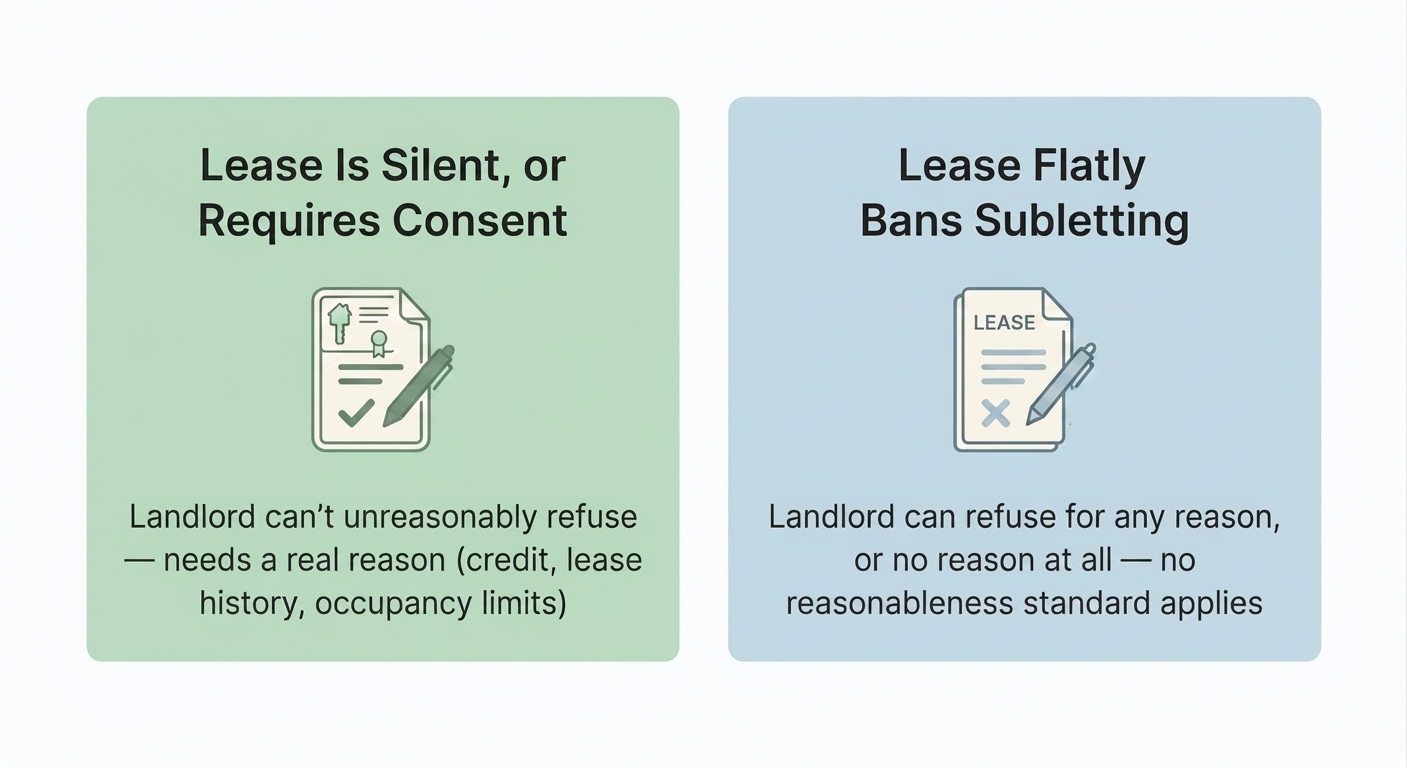
If your lease is silent on subletting, or requires consent without saying the landlord has absolute discretion, California law says your landlord can't unreasonably withhold that consent — they need a real, commercially reasonable objection, like your proposed subtenant's poor credit, a documented history of lease violations, or exceeding occupancy limits. If your lease flatly bans subletting, none of that applies — your landlord can refuse for any reason, or no reason at all.
In San Francisco specifically
Two rules worth knowing if your rental is in San Francisco — these are local to SF and haven't turned up as standard elsewhere in the Bay Area, so don't assume they apply outside the city.
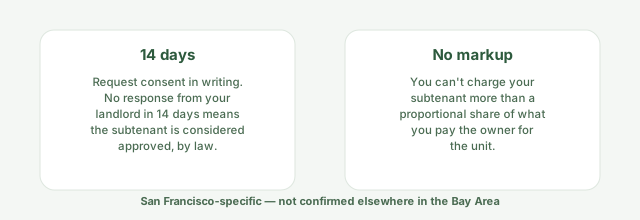
If you request consent in writing and your landlord doesn't respond within 14 days, your subtenant is considered approved by law. And you can't charge your subtenant more than a proportional share of what you pay the owner for the unit — no markup for yourself. San Francisco also has a specific carve-out letting you replace a departing roommate with a new one even if your lease bans subletting outright.
You're still on the hook to your landlord, no matter what
If your subtenant stops paying rent, you still owe your landlord the full amount — that's not something you can point at your subtenant to get out of. Any shortfall can come out of your security deposit with your landlord, on top of whatever your subtenant owed you. This is worth sitting with before you sublet: you're taking on real financial exposure, not just paperwork.
You take on landlord-like duties toward your subtenant
If you collect a security deposit from your subtenant, you're now responsible for handling it the way an actual landlord would — an itemized list of any deductions, and returning what's left in a timely way. The deeper mechanics you share with owner-landlords, like just-cause eviction protection and written disclosure requirements, are covered in our other Legal & Compliance guides rather than repeated here.
What happens if you skip the consent step
In San Francisco, subletting without approval after 12 months of tenancy is an at-fault "just cause" for eviction — but it comes with a cure window, not an automatic loss of your home. Landlords must give a 10-day notice to cure, and you can cure it by removing the unapproved subtenant or formally requesting approval. Worth knowing the actual stakes, without assuming the worst-case outcome is the only outcome.
Ready to start screening? See how Key works.
If you want help with this part
Key doesn't handle your consent request or your deposit obligations, but once you're ready to hear from applicants, it runs the same intake process regardless of whether you own the place or are subletting it.