House Hacking in the Bay Area: How It Works and What It Actually Costs
Bay Area home prices are high enough that buying alone often doesn't pencil out on a typical income. "House hacking" is the term for the strategy that changes that math. Here's what it actually means, how the financing works, and how to check the real numbers for a specific property.
What house hacking actually means
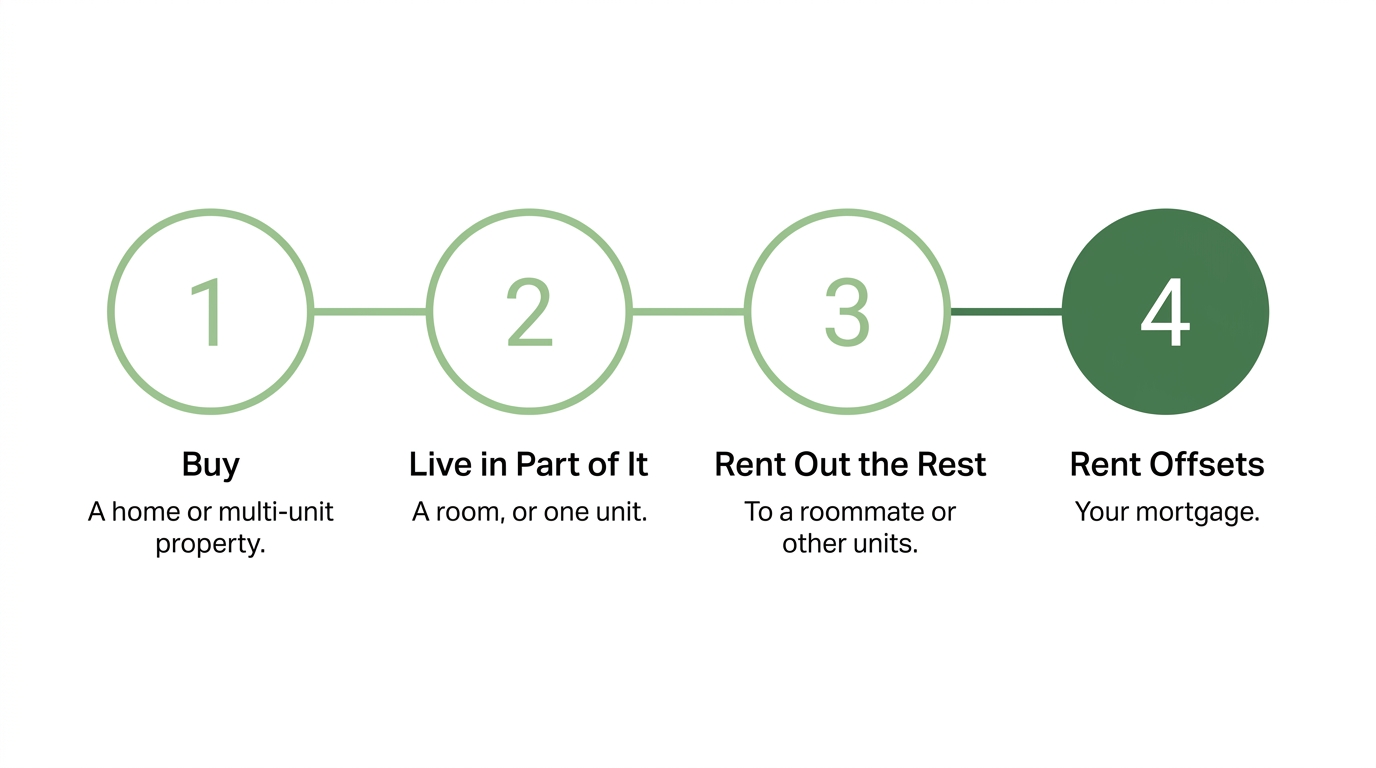
You buy a property, live in part of it, and rent out the rest to help cover the mortgage. That can mean renting a spare room in a single-family home, or buying a duplex, triplex, or fourplex and renting out the units you're not living in.
Glossary: the terms you'll actually run into
- FHA loana mortgage insured by the Federal Housing Administration, a government agency. The loan itself still comes from a regular private lender; the government backing is what lets lenders offer lower down payments and more flexible credit requirements than a typical loan.
- Owner-occupantyou're required to actually live in the property as your primary residence, not just hold the deed. This is the condition that unlocks house-hacking-friendly financing.
- DTI (debt-to-income ratio)how lenders measure what you can afford: your monthly debt payments divided by your monthly income. A lower ratio generally makes you easier to approve for a bigger loan.
- PITIprincipal, interest, taxes, and insurance, added together. This is your actual full monthly housing payment, not just the loan payment.
- Self-sufficiency testfor FHA purchases of 3-4 unit properties, a check that the property's expected rental income can cover its own PITI on its own, without counting your other income.
How FHA financing changes the numbers
FHA loans allow owner-occupant financing on properties with up to 4 units, with a down payment as low as 3.5% on a duplex, or 5% on a 3-4 unit property. The bigger difference is on the income side: lenders will count 75% of the projected rental income from the units you're not living in toward your qualifying income — this is the actual mechanism that makes a larger purchase reachable on a given income.
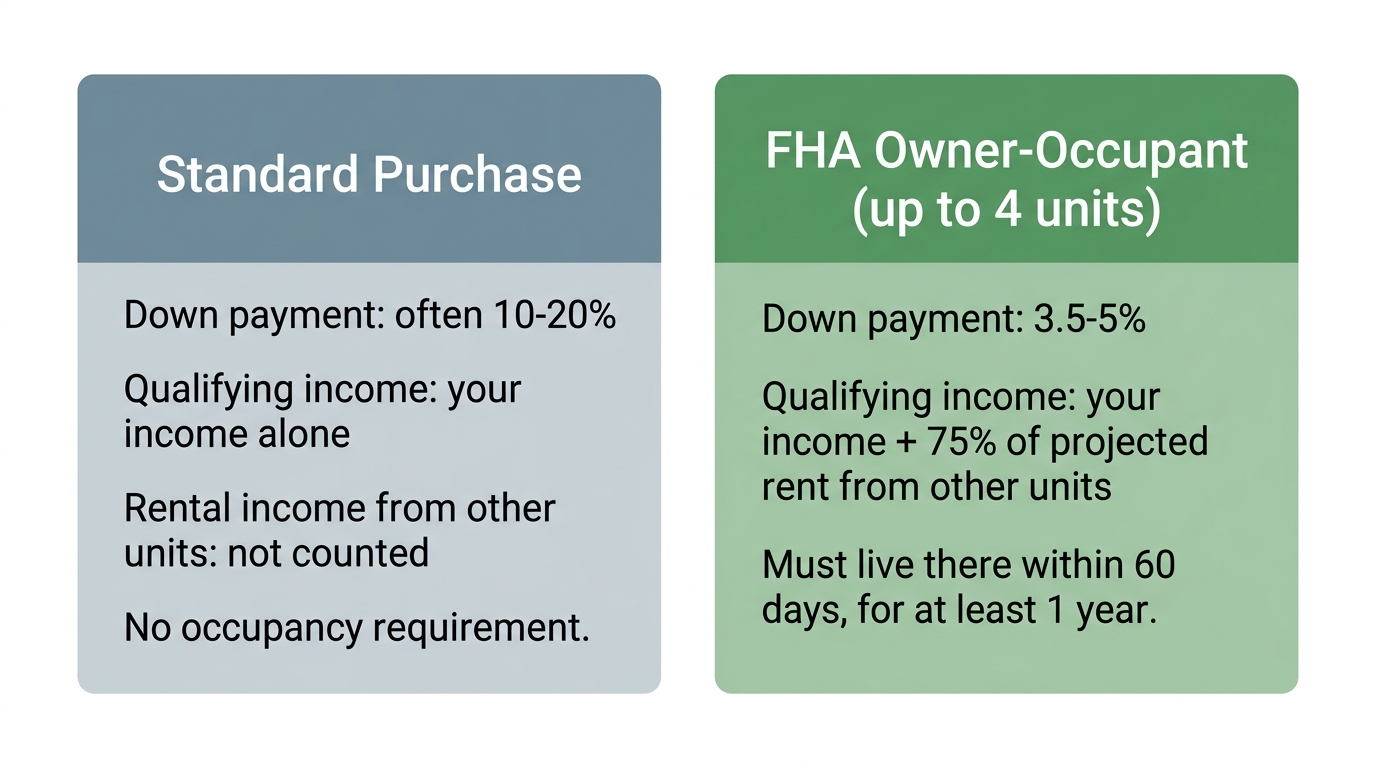
There's a real condition attached, though: you have to move in within 60 days of closing and stay at least a full year. You can't rent out your own unit during that year — a spare room is fine, since you're still living there.
A common misconception worth clearing up: FHA loans aren't limited to first-time buyers. Anyone can qualify regardless of homeownership history, as long as the property will be your primary residence and you meet the usual credit and income requirements. The real restriction is that you can typically only hold one active FHA loan at a time, not that you've never owned before.
Why this shows up so often in the Bay Area specifically
This isn't a niche strategy here — Bay Area home prices are high enough relative to typical income that house hacking is often the realistic path to owning at all, not just an optimization. As one illustrative scale: a roughly $1.5M Bay Area duplex financed with FHA at 3.5% down comes to about $52,000 up front, a very different number than a 20% down payment on the same property.
Does it actually pencil out for a specific property?
That depends entirely on the property, the rent it can realistically bring in, and your own numbers — not something a general post can answer for you. Nest & Key's rental income calculator is built for exactly this: enter a home price, down payment, mortgage rate, and expected room or unit rent, and it shows what that actually does to your monthly payment.
Ready to start screening? See how Key works.
If you want help with this part
Once you've run the numbers and decided to house hack, Key handles the same intake and screening process for whoever responds to your listing — no different from any other landlord situation.